Ready for a different Games: Behind the scenes of Glasgow 2026
For HPSNZ Head of Performance Nutrition Christel Dunshea-Mooij, who is seconded to the NZOC’s Core Support Team, Glasgow has presented unique challenges.
Christel is an experienced campaigner, having attended four Olympic Games and one previous Commonwealth Games. This year she is half of the two-person Preparation and Recovery Team (PRAT), alongside fellow HPSNZer, Physiologist Stephen Fenemor. She will also wear her performance nutrition hat in the lead up to and throughout the 11-day Games.
“This will be my second Commonwealth Games,” says Christel. “The field of play will be exactly the same, but the way the Games operate behind the scenes is very different.”
Unlike previous Commonwealth Games, Glasgow 2026 is smaller, with 116 New Zealand athletes spread across multiple hotels rather than a traditional athletes’ village. Hotels remain open to the public, transport options are more limited, and many services athletes and support staff have come to expect at pinnacle events have needed creative alternatives.
As one half of the PRAT team, Christel’s role is to remove barriers that could impact performance.
“Our focus is making sure athletes have consistent, practical access to everything they need to prepare and recover effectively,” she says. “That includes everything from recovery environments through to making sure athletes can access the right food at the right time.”
Nutrition has been one of the biggest planning challenges.
Christel has spent months working with organisers, hotel food and beverage managers and fellow Commonwealth Games nutrition leads to ensure athletes’ needs are understood and accommodated.
Every sport has different requirements. Weightlifters need post weigh-in meals, netballers require pre-match fuelling and late-night recovery food after evening matches, while endurance athletes often need meals outside standard dining hours.
Christel is part of an international group of performance nutritionists who have reviewed menus from all 16 athlete hotels, coordinated dietary requirements, and worked with organisers to negotiate extended dining times and additional meal provisions for sports with unique competition schedules.
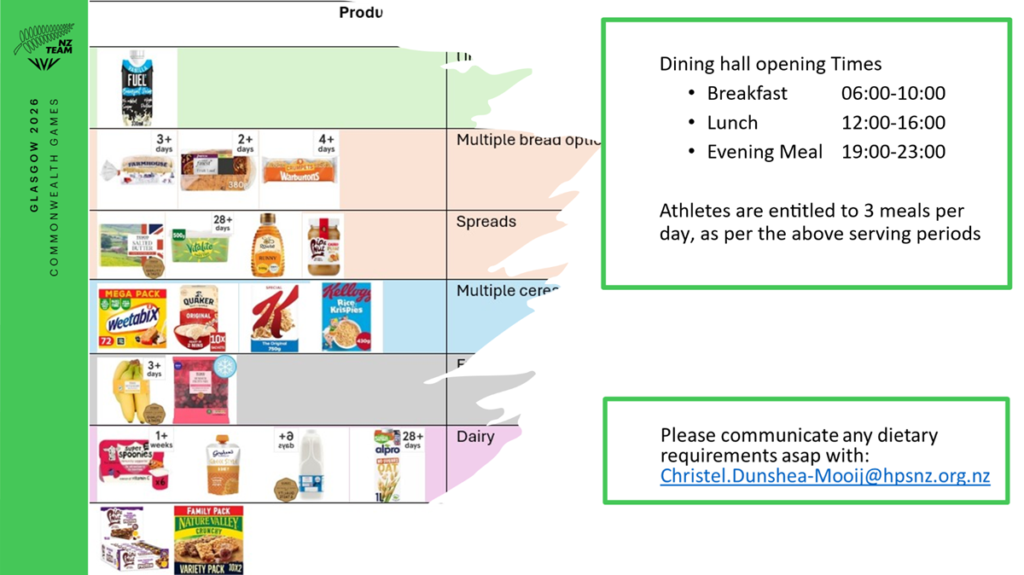
The team has also mapped competition timetables to identify potential fuelling pinch points where athletes may need access to nutrition when dining facilities are closed.
To bridge those gaps, the team has established recovery stations across all athlete hotels, stocked with equipment shipped from New Zealand and supplemented by daily supermarket deliveries. The stations will provide practical options such as snacks, recovery foods and simple meal preparation facilities, ensuring athletes can access appropriate nutrition when restaurant opening hours don’t align with competition demands.
Christel and her colleagues have also had to source and install additional fridges, microwaves, toasters, toastie makers and smoothie makers, creating flexible nutrition hubs that can support athletes throughout the Games.
The scale of planning is significant. By the end of the Games food orders from the local supermarket will have included more than 1,200 bananas, 1,200 apples, 1,300 yoghurts, 1,271 high-protein breakfast drinks and hundreds of loaves, cereals and snack items.
Two sea freight containers carrying supplies, equipment and recovery resources have been shipped from New Zealand, with the team arriving in Glasgow just days before athletes begin competing.
Recovery planning has required similar innovation. The team is establishing ice bath facilities and adapting existing hotel gyms rather than building dedicated Games infrastructure.
“You learn very quickly to be flexible,” says Christel. “There are always solutions, and major events are great examples of people finding practical ways to make things work.”
As competition begins, Christel says one message has remained consistent for athletes and support staff alike: expect something different.
“It won’t look like previous Commonwealth Games, but it will still be an amazing experience,” she says. “The goal is simple — to make sure our athletes arrive at the start line, court, pool or platform ready to perform when it matters most.”