What is Low Energy Availability and Relative Energy Deficiency in Sport?
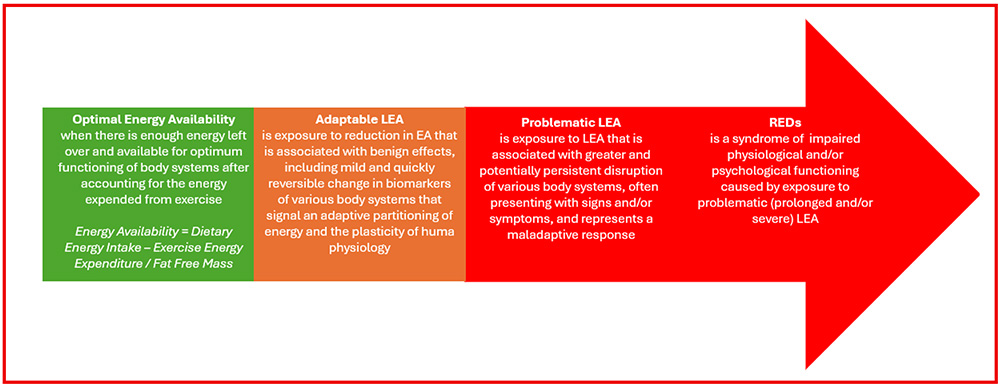
Low energy availability (LEA) is any mismatch between energy intake from the diet and the energy used in exercise that leaves the body with inadequate energy to support optimal health and performance.
There is a spectrum of LEA severity, ranging from situations where the effects are mild (adaptable LEA) to where there are significant and possibly permanent performance and health impairments (problematic LEA). Relative Energy Deficiency in Sport (REDs) is syndrome that can be caused by exposure to problematic LEA (prolonged and/or severe) and has an impact on health and performance. LEA is the exposure, and REDs is the eventual outcome.
Who is at risk of LEA?
Any individual exercising can be at risk for developing LEA. LEA can occur with any body type, at any body mass and in both men and women. Athletes that have traditionally been more affected by LEA include:
- those with an emphasis on leanness and physique (e.g., gymnastics, diving)
- endurance sports where energy expenditure is significant (e.g. distance running, cycling, triathlon)
- those where a weight category is implemented for competition (e.g. weightlifting, combat sports)
How does LEA start?
In many athletes, LEA is the result of accidentally not meeting the energy needs of their sport, exercise activity or daily life. Athletes may find themselves to have LEA due to a lack of knowledge or understanding of nutrition, being influenced by eating habits of others or other social factors such as dietary trends or social media. This accidental LEA may be due to:
- an increase in training volume and/or intensity without increasing dietary energy intake
- lack of time or thought for food preparation/organisation
- eliminating foods/food groups
LEA can also result from ‘disordered eating behaviours’ or formal ‘eating disorders’ which may cause significant health concerns. This may include excessive ‘calorie (energy) counting’, skipping meals, binging or purging (vomiting), deliberately changing eating patterns to achieve a certain look, overly focussed on healthy eating (Orthorexia), or using medications to cause weight loss without medical advice.
Signs of LEA
LEA is formally defined as having “limited energy available to support the normal body functions, once the energy expended through exercise is subtracted from the total dietary energy intake.” LEA is not necessary accompanied by weight loss. The body has amazing mechanisms to conserve energy for survival and can maintain overall body weight even when there is not enough energy. One way to preserve energy is to shut down ‘non-vital’ body systems such as the menstrual cycle. As a result, weight on its own is not a great guide to the presence or absence of LEA.
How to make sure you’re eating enough for the training you’re doing:
- consume meals, snacks, and recovery foods regularly throughout the day to ensure adequate energy and nutrient intake
- energy requirements change depending on the intensity and duration of training, so food intake should be adjusted accordingly
- avoid long periods without eating. Fuelling before, during, and after training supports performance and recovery
- be cautious of information and trends on social and mainstream media
- a NZ Registered Nutritionist/Dietitian can help make sure nutritional needs are being met for the specific demands of the sport
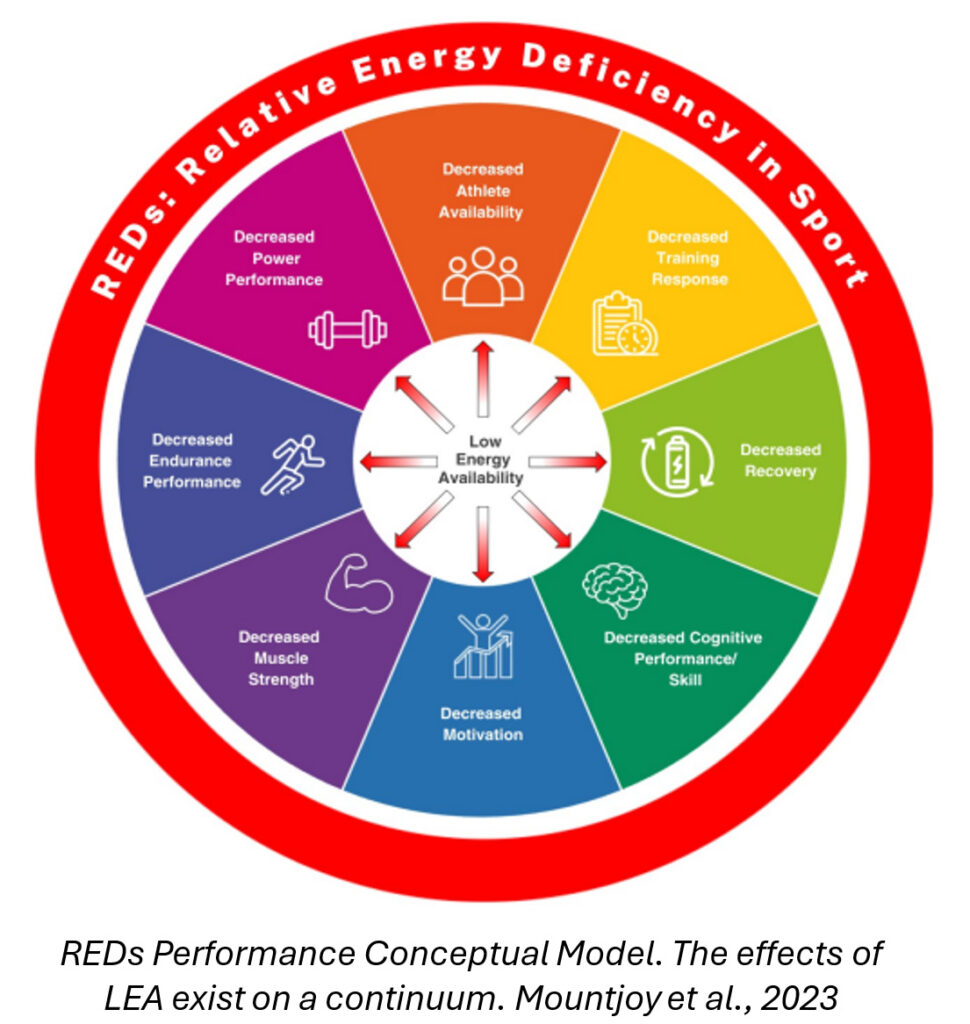
Sustained exposure to LEA may have a significant impact on health and athletic performance:
- frequent or repeated illnesses (e.g. coughs, colds, skin infections, stomach bugs)
- recurring injuries that do not get better (e.g. stress fractures)
- absent or irregular menstrual periods
- loss of enjoyment from sport
- tired, sluggish, not recovering from training
- poor concentration, reduced interest, low mood
- under performing in training and competition
Diagnosing and investigations for REDs
REDs can be difficult to diagnose, and it may have multiple causes. REDs is a diagnosis of exclusion, so it’s important to see a Medical Doctor if REDs is suspected. In elite sport, checking for REDs might involve a team of experts—like Medical Doctors, NZ Registered Nutritionists/Dietitians, and Clinical Psychologists. Tests could include blood work and/or scans.
Managing REDs involves a team approach and ongoing support:
- identifying and addressing causes (including assessing the athlete’s cognitive restraint to the required behaviour change and for disordered eating behaviours)
- ensuring appropriate energy from the diet is consumed over time to meet the daily demands of exercise
- addressing energy expenditure through adapting or ceasing training and competition loads, as necessary
- regular check-ins with the team to track progress and adjust the plan as needed
References:
Burke LM, Ackerman KE, Heikura IA, et al. Mapping the complexities of Relative Energy Deficiency in Sport (REDs): development of a physiological model by a subgroup of the International Olympic Committee (IOC) Consensus on REDs. British Journal of Sports Medicine 2023;57:1098-1110
Mountjoy M, Ackerman KE, Bailey DM, et al. The 2023 International Olympic Committee’s (IOC) consensus statement on relative energy deficiency in sports (REDs). BJSM 2023. doi:bjsports-2023-106994