The menstrual cycle is the monthly series of changes that a woman’s reproductive system undergoes in order to be prepared for a possible pregnancy.
One cycle is from the start of bleeding (period) to the start of the next period and is roughly (give or take a few days) consistent each month.
There are 4 main hormones that fluctuate in level during the cycle, which control the menstrual cycle:
- oestrogen (produced in the ovary)
- progesterone (produced by the unfertilised ‘egg’ or ‘ovum’)
- follicle stimulating hormone (FSH) (produced by the brain)
- luteinising hormone (LH) (produced by the brain).
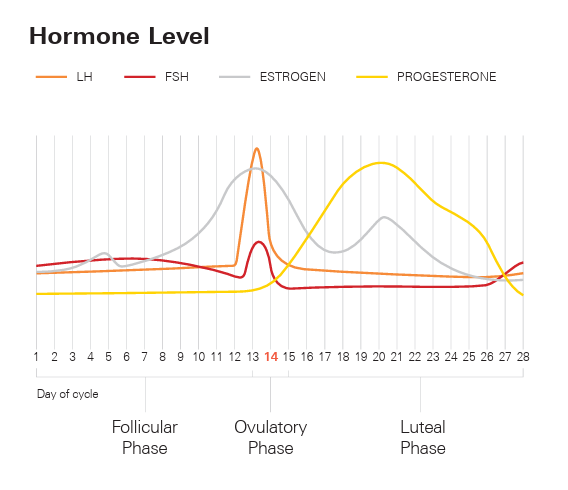
What causes the menstrual cycle?
- Day one of a cycle is considered the first day of a period. At this point all the body’s hormones are at a low level.
- Oestrogen levels then increase, to stimulate egg production in the ovary (this is known as the follicular phase of the cycle).
- Once oestrogen reaches a certain level, and the egg is ready to be released from the ovary, LH sharply rises. This sharp rise causes the egg to be released from the ovary (this is called ovulation and occurs at about the middle of a cycle).
- After ovulation, oestrogen, LH and FSH levels decline and progesterone starts to rise.
- Progesterone continues to thicken the lining of the uterus wall (the ‘endometrium’) to receive a fertilised egg (this is known as the luteal phase of the cycle).
- If the egg isn’t fertilised, then the progesterone level falls, and the endometrium ‘comes off’ the uterus wall. This is the period (also known as menses).
How long is a menstrual cycle?
- A menstrual cycle between 21 and 36 days is considered normal.
- Many women don’t have exactly the same number of days in each cycle. Two or 3 days on either side is common. However, a week or more on either side does suggest an irregular cycle.
- Menstrual cycle length normally remains quite steady for an individual woman from about 2 to 3 years after periods start until the menopausal transition, with the exception of pregnancy.
When do periods start?
- Periods usually start anywhere from age 9 to 16.
- Breast budding is the most common first sign of puberty. Periods will start about 2 years after breast budding starts.
- It is very common and normal to have an irregular cycle shortly after periods start. This cycle irregularity can last for 2 years but then will typically develop into a regular cycle.
- If your periods haven’t started either before age 16 or within 3 years of breast budding, follow-up with a General Practitioner (GP) is recommended.
How long and heavy is a period?
- This varies between individuals.
- The length of periods may vary, but 3 to 7 days is typical.
- The amount of bleeding during a period varies. Some women don’t need much more than a liner, while others may need a super tampon changed every couple of hours, particularly in the first 2 days.
- Heavy bleeding (menorrhagia) is defined as greater than 80ml per day. Changing a super tampon and/or a thick pad every 2 hours, or waking at night to regular flooding, would be consistent with menorrhagia.
- Small clots are normal but bigger clots are not.
- Large clots and flooding should both be followed up with a GP.
How painful are periods?
- Most women get some discomfort, but a period shouldn’t stop you from doing anything.
- Should a period be so painful that you miss school, study or training, then it may be time to see a doctor. The pain of periods is known as dysmenorrhoea.
- Period pain is the result of chemicals causing the muscles of the uterus to contract, thereby squeezing the endometrium out of the uterus.
- Exercise can help dysmenorrhoea.
What is premenstrual syndrome (PMS)?
- PMS describes cyclical symptoms that start several days before a period, and typically resolve with the onset of menstruation. Symptoms can include abdominal bloating, breast soreness, mood swings, increased hunger, increased thirst and acne. Not everyone experiences PMS and the range of symptoms is enormous.
- PMS usually finishes within 1 to 2 days of the period starting.
- Adequate sleep and exercise are the most effective treatment.